

As artificial intelligence continues to transform nearly every sector, construction and BIM Coordination are no exception. With the introduction of powerful AI tools that can automate clash detection, predict scheduling conflicts, and optimize workflows, many construction professionals are asking: will AI replace BIM Coordinators?
It’s a fair question, especially as technology grows more capable. But the answer is more nuanced than a simple yes or no. At BIM Synergistics, we believe that AI will enhance the role of BIM Coordinators, not replace it. Here’s why.
The Role of a BIM Coordinator
Before diving into the impact of AI, it’s worth understanding what a BIM Coordinator does. A BIM Coordinator is responsible for managing digital models across disciplines, ensuring that architectural, structural, and MEP elements integrate smoothly in a single federated model. They lead coordination meetings, resolve design conflicts, ensure compliance with project standards, and translate design intent into actionable construction documentation.
This role requires more than just technical skill. It involves critical thinking, collaboration, knowledge of construction sequencing, and the ability to work with multiple stakeholders, from architects and engineers to subcontractors and owners.
What AI Brings to the Table
AI is making meaningful contributions to the BIM process. Tools powered by AI and machine learning can:
-
Automate clash detection faster than traditional model-checking tools.
-
Analyze model performance and suggest optimizations for energy, cost, and constructability.
-
Flag design anomalies that deviate from standards or past projects.
-
Support scheduling and sequencing through predictive analytics.
-
Track model versions and assist in identifying changes across time.
These capabilities are helping teams reduce human error, increase efficiency, and accelerate decision-making.
But AI Can’t Do Everything 
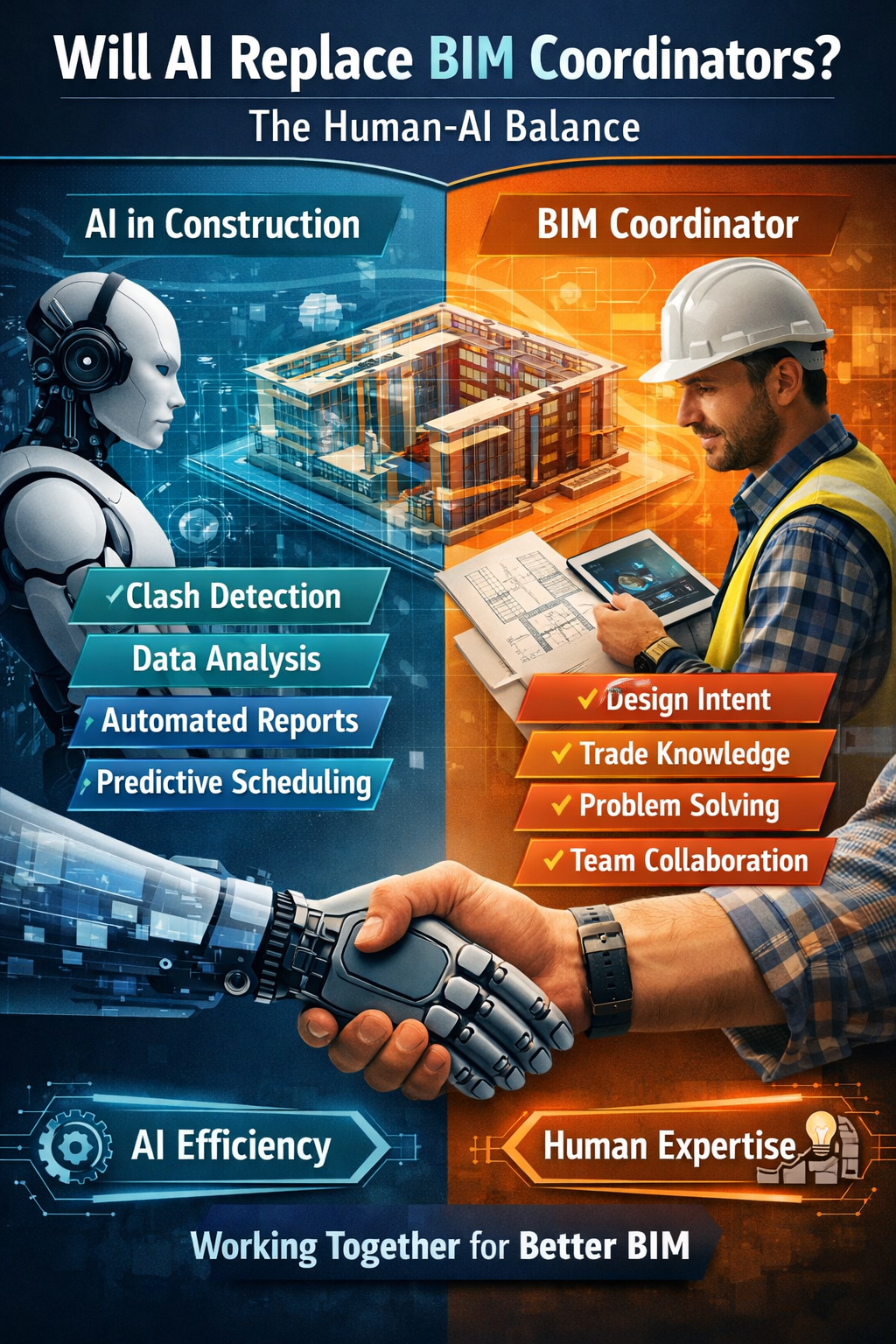
Despite these strengths, AI still falls short in areas that require judgment, experience, and human connection. For instance:
-
Interpreting Design Intent: AI doesn’t understand why a design choice was made or how it connects to a broader architectural vision.
-
Contextual Trade Knowledge: Coordinators often use years of practical field knowledge to make informed decisions about constructability, safety, and logistics.
-
Conflict Resolution: BIM Coordination is inherently collaborative. Coordinators must navigate differing opinions, mediate between stakeholders, and communicate clearly; tasks AI cannot replicate.
-
Customization and Flexibility: Every project is unique. While AI works well with rules and patterns, human Coordinators adapt quickly to project-specific needs, personalities, and shifting goals.
Ultimately, BIM is about communication. A good Coordinator translates complex data into clear direction. That requires empathy, leadership, and intuition, all uniquely human traits.
Human + AI: A Powerful Partnership
Rather than viewing AI as a replacement, the industry is beginning to embrace it as a partner. BIM Coordinators can use AI to:
-
Automate repetitive tasks, freeing up time for strategy and planning.
-
Get faster insights from models, allowing for more proactive decision-making.
-
Strengthen model health with data-driven recommendations.
-
Deliver higher-quality coordination meetings with the aid of AI-prepared reports.
This collaboration leads to better outcomes for project teams. Instead of spending hours combing through clashes or manually verifying revisions, Coordinators can focus on solutions, relationships, and oversight.
What This Means for BIM Synergistics Clients
At BIM Synergistics, we integrate AI tools into our BIM Coordination and BIM Process workflows to enhance speed and accuracy, but always with a human at the center. Our team understands the nuances of mechanical systems, duct clearances, plumbing slopes, and electrical routing in a way that algorithms alone cannot.
We leverage automation where it helps most, and rely on our team’s construction intelligence where it matters most. The result is a better-coordinated project, faster turnaround, and fewer issues during construction.
Whether you’re a GC in Coeur d’Alene or a national MEP contractor, working with a partner who knows how to balance people and technology gives you a serious competitive edge.
The Future of BIM Coordination Is Human-Led, Tech-Enabled
BIM Coordinators are evolving. As AI becomes more sophisticated, the best Coordinators will be those who know how to integrate its insights into a larger strategy. Their role will shift from model checker to BIM strategist, capable of aligning digital models with real-world outcomes.
Firms that recognize this shift will benefit most. They’ll avoid hiring blindly based on software skill and start looking for professionals who understand how to lead teams, interpret data, and make judgment calls that align with both design and construction goals.
AI will not replace BIM Coordinators, but it will redefine their role. The future belongs to teams who embrace both innovation and human expertise. At BIM Synergistics, we’re ready for that future, and we’re helping clients lead the way.